I watched from the uppermost row of the balcony, seated on a folding chair, as the baritone whose name I no longer remember sang onstage. This was the aria “Kennst du Das Land” from Mark Adamo’s operatic setting of Little Women, written only two years before, with this snippet of Goethe’s poem set to new music for the character of Professor Bhaer to sing to Jo. In the opera, he means it as a rejoinder to the separation of high and low art, with some narrative significance, but what I remember are the ever-shifting resolutions, billowing upward to the limits of the baritone range. There are flourishes of harmonic romanticism around the first-simple melody, contrasting with the often-atonal score of the rest of the opera. Bhaer sings first in German, then in English translation, allowing me to hear the inexplicably-triumphant peak twice in every performance.
I say “every performance” because I saw at least seven of them. In 2001, I was working at the summer festival of the Central City Opera, high in the Rockies outside of Denver, housed in an opera house built by Welsh miners in the 19th century. I presume that professional and apprentice singers appreciate this setting for the same reasons that marathoners train at altitude: thin air makes for strong lungs. But I was a generalist college student, and I was there to work on the staff as a music librarian and usher. In rehearsals I would distribute scores and parts, marking bowings for the strings and scrambling to rewrite sections as the conductor adjusted to conditions. But during performances I would wear the most elaborate tuxedo of my subsequent lifetime, taking tickets, directing patrons, and finally, when all was settled and the curtain rose, unfolding my chair near to the rafters and drinking in the unexpected pleasures of real opera.
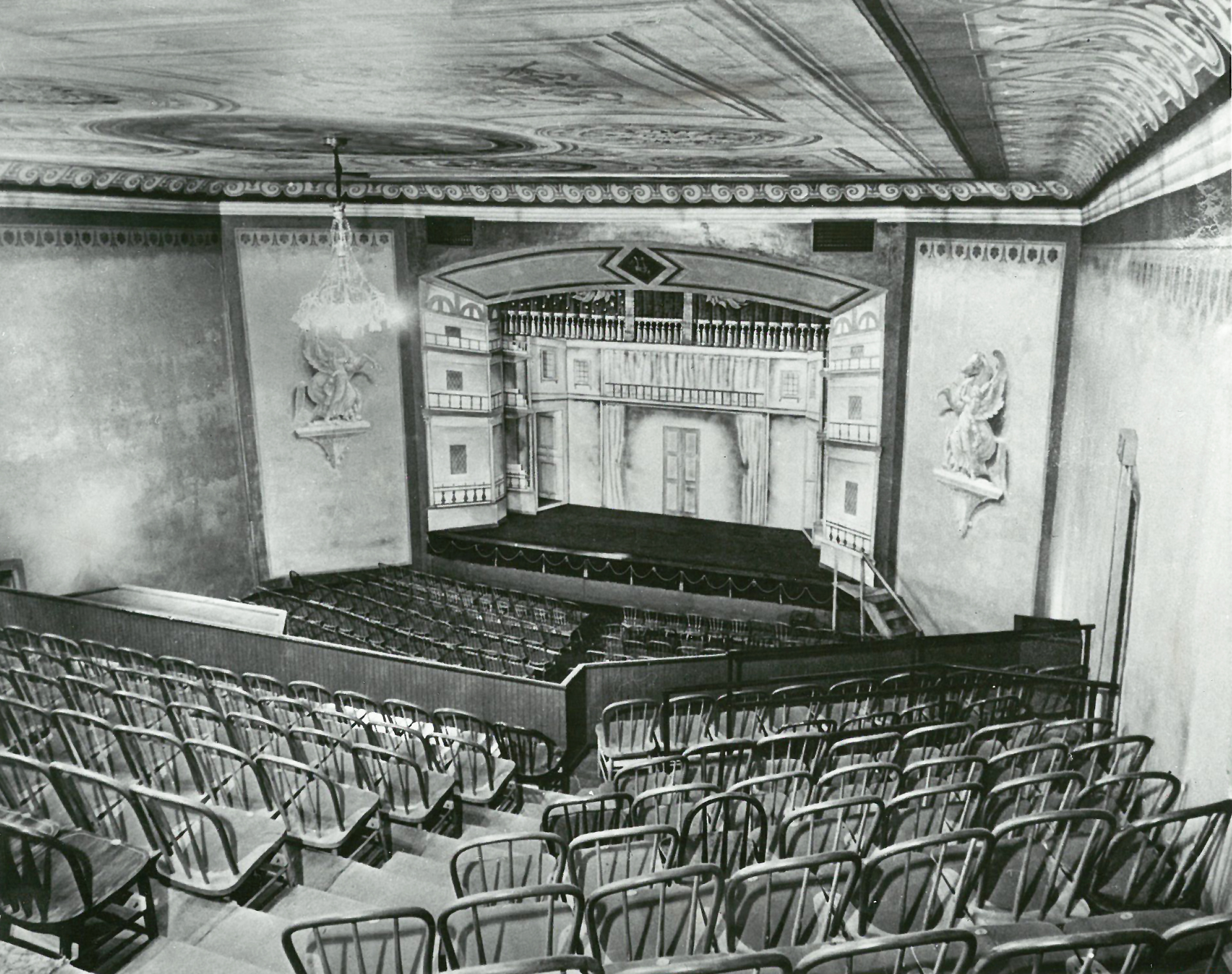 View from the balcony of the Central City Opera House, ca. 1932, historical photo by CCOHA
What I have forgotten from two summers there is voluminous. I’ve lost so many names. I can’t picture where I slept, where I bathed. My sense of the geography of the old mining town has warped, with steeply-sloping streets melting into each other. I remember that I kissed a girl for the first time there, while we sat on a boulder above it all, but I couldn’t say how we got there or what the weather was like. I recall that I walked for miles and miles into the hills on my days off, but I can’t picture any of those roads. I have no recollection of what foods I ate or where they came from. I don’t know if I started my mornings with coffee.
But I remember the music.
I remember the bounce and excitement in the old stone theater as the overture of Bernstein’s Candide first flowed out of the orchestra pit. I can hear the shattering brass of Benjamin Britten’s Gloriana as Essex is condemned for his rebellion. I can grasp at parts of the Italian libretto for La Traviata, and I can hear the notes of the trumpet exercises I worked through in the mornings. And note for note I recall the Kennst aria, as well as Candide’s torn lament It Must Be So, accompanied by a harpist across rippling shifts in key.
The internet is unforgiving of the earliest parts of this century. I can find no recordings online of Little Women from that summer in Colorado. The first recording of Kennst that turns up is a youtube video from State Opera South Australia, in a chamber setting with just a piano accompanying the singer. It’s still enjoyable, but it’s not what I remember. In a sense, the internet never knew about this obscure corner of opera performance - itself already an obscure part of music - so how could it forget? When I was even younger, I would religiously listen to Fiona Ritchie’s Thistle and Shamrock program on public radio, and many of those traditional tunes that remain lodged in my head are part of no recorded catalog that I can find from my laptop. I’m sure they’re still out there somewhere - if I had the legs to seek them out in person like Alan Lomax - but so much music never made the leap into digital and so it seems to remain only in a warren of my memory.
In another phase of my education I was in a music therapy class, and one day we were shown a video of an elderly man, said to be nearly catatonic in the late phases of dementia. A clinician put on an old Glenn Miller recording, and I nearly gasped as I watched clarity enter the patient’s eyes, and he began moving, first in his seat, and then standing and shakily dancing, smiling. I remember him remembering, with the old song jumping from his ears directly to pristine neurons. The science supporting this is sparse, but at times convincing.
The SSA’s actuarial tables suggest that I will die in the year 2059, and there is dementia in my family history, so I can’t expect to be of sound mind at the end. By then it will have been nearly sixty years since I heard Adamo’s Kennst du das Land live. But if someone were to sing it for me in whatever institution I inhabit, I do expect to recognize it. To remember.
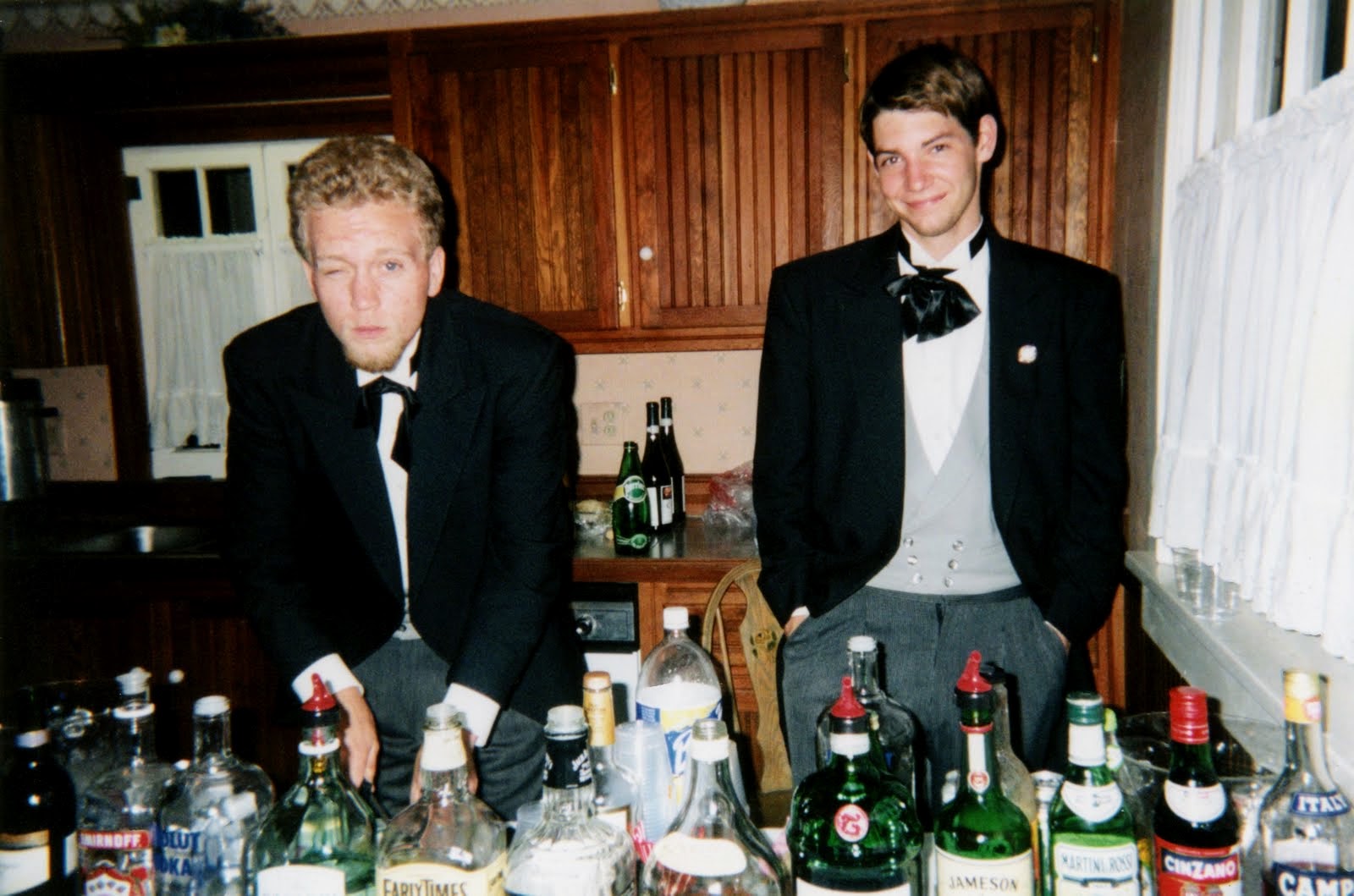 The author (left) and a fellow usher tending a possibly-informal bar during the summer season, ca. 2000